Sunday, January 20, 2013

Udon

Kama-age udon 釜揚うどん, or udon noodles in broth, are a winter seasonal food; apparently it also counts as a winter kigo in haiku poetry. Apparently the Japanese must have felt that eating a bowl of noodles in hot broth was a great thing to do.

Eight years ago today I was in Kyoto. In the morning, I woke up and found the city covered in snow. I spent the next few hours around the Higashiyama area, taking pictures like this one:

Kyoto Snow
February 2005
Digital

By noon, I was near the Sumitomo Museum, and I remembered a small place where I had had lunch on an earlier visit. On my second visit I had a fantastic bowl of udon in broth, which I still remember although I do not remember what else was in it. But I guess the kigo masters are right, it is the broth that is memorable on a snowy day!

Winter Food

Some foods are supposed to taste best in winter. My mother would put in this group rather hearty things, like salsiccia (sausage) with beans, or polenta (which she only serves with rich, tasty toppings, like ragu, known here as the sauce in spaghetti bolognaise). Further north, in Lombardy, people think of brasato, slow-cooked beef, as typically wintry. Choucroute alasacienne (sausage and sauerkraut) feels the same way.

Salsiccia, along with a number of other pork products like zampone and cotechino, does not keep very long. Pigs were traditionally slaughtered in December, probably because by December fodder was scarce and, in a world without refrigerators, the cold afforded more time to cure the meat or eat it fresh.

Nowadays, we can pretty much get any vegetable or fruit at any time of the year. It is great that food transportation enables South-American farmers to get some crumbs from the table of North-American affluence. Of course, this produce has to travel long distances and be stored, and it tastes like water (some people use stronger words). And when the grocery store tries to market New Zealand apples in Washington state, we are in refrigerators-to-eskimos territory.

From the point of view of enjoyment, I do not think we actually gain anything from the availability of out-of-season fruits and vegetables. We lose the interest of anticipation, and they are not good anyway.

My father used to rave about the flavor of leeks and cabbages, usually ones he had grown, and I used to think he was from another planet. I now realize that he is right. Today I made a zuppa, a soup, of farro (spelt, a variety of wheat) and winter vegetables. It was great, and it has to be eaten in winter.

Here is what I did: I sliced a small onion thin, fried it in oil with a half habanero pepper until it became soft, then added two espresso cups of spelt (espresso cups are a great measure of how many grains are needed for one person; my grandmother measured rice the same way). I stir fried for a couple of minutes, then I added a thinly-sliced cup of cabbage, and stir-fried that too for another minute. Then I added about two cups of water, a small carrot (sliced), and one celery stalk, also sliced. I brought everything to the boil, and took it off the fire. Three or four hours later, when it was time to eat, I warmed it up again. The spelt was just chewy enough.

Saturday, January 19, 2013

Big Cold

Tomorrow, January 20th, is the start of the "Big Cold" solar term in the Chinese calendar.

大寒


Big Cold is the last term of the year in the Chinese calendar. We are approaching Chinese New Year, which this year will fall on February 10th. Since Chinese New Year is a moveable feast, it may not belong here at all. However, unlike the Muslim months, it does predictably take place in this cold time of the year, so maybe I will.

The Big Cold term follows "Small Cold", which ends today. This year, here in Seattle, the term lived up to its name fairly well: the last four or five day have been around freezing, and in thick fog.

Friday, January 18, 2013

The Brown God Is Almost Forgotten


The seasons have gone much the same way as the river, T.S. Eliot's strong brown god: they are now

... only a problem confronting the builder of bridges.
The problem once solved, the brown god is almost forgotten
By the dwellers in cities - ever, however, implacable,
Keeping his seasons and rages, destroyer, reminder
Of what men choose to forget. Unhonoured, unpropitiated
By worshippers of the machine, but waiting, watching and waiting.
The Dry Salvages
 
 
The combination of the clock and electricity have really led us to ignore the seasons. The clock gives us a fixed time, independent of the sun, and makes us come home when it is pitch dark in winter, and mid-afternoon in summer. Electric lighting enables us to forget that the sun has even gone down; and by living in climate-controlled buildings, and driving everywhere, we forget that it is cold in winter and warm in summer.
 
I think we lose something in the process. The changing of the seasons is one of the wonders of nature, and it is worth getting off the iPad to pay attention to it. Moreover, dealing with the weather is part of what we are as animals, and we should respect what we are. We are not only brains connected by the Internet; we are also cold and warm, and hungry, and horny.


Tuesday, January 15, 2013

Kigo

季語

I came across this resource today: http://wkdfestivalsaijiki.blogspot.jp/2012/05/january-calendar.html. It is a web site entirely devoted to kigo (季語), the "seasonal words" used in Japanese poetry.

Kigos are a treasure trove of observations about the times of the year and what makes them distinctive. I am looking forward to spending some time on this site.


Saturday, January 5, 2013

Small Cold

Tomorrow, January 6th, is the start of the "Small Cold" solar term in the Chinese calendar.

小寒


In parallel with the months, the Chinese also divide the year into 24 "solar terms" (节气 jiéqì, where 节is a node or a segment and 气 is the air or the weather). The names of the solar terms are based on the weather conditions prevailing in Central-North China, where Chinese culture developed.

I do not know when exactly these names became established, but they are old: the same names, almost character for character, are used in Japanese, which suggests that the system was already in use in the mid-7th century, when the Japanese adopted Chinese writing. The solar terms are used in Korea, too.


Friday, January 4, 2013

Cyclical Time

I believe it was Arnaldo Momigliano who pointed out that the idea of linear time entered European thought with the judeo-christian influences in late Antiquity. Linear time proceeds from Creation to Salvation to Final Judgment and the end of times, and all of this is pre-ordained ab initio.

But what is interesting to me here is the smaller scale of daily experience. In daily experience, time was essentially cyclical for all pre-modern societies:

The sun also ariseth, and the sun goeth down, and hasteneth to his place where he arose.
 
... To every thing there is a season, and a time for every purpose under the heaven:
A time to be born, and a time to die; a time to plant, and a time to pluck up that which is planted.

(Ecclesiastes, 1:5 and 3:1-2)


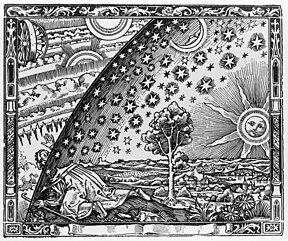
Anonimous - The Flammarion Engraving
 

Incipit

Yesterday was a cold, crisp day, with beautiful views of the mountains, all covered in snow. I spent the day in the back yard, cutting down trees, sectioning them, and putting them away as firewood.

I was reminded of this depiction of the month of December, one of Antelami's pictures of the months in Parma's Battistero:

In the afternoon, I went back into the house and ate a late lunch of red cabbage and garlic. And I thought: doing the works of the month and eating the vegetables of the season really feels quite good.